
Real Inclusion, Real Partnership, Real Purpose
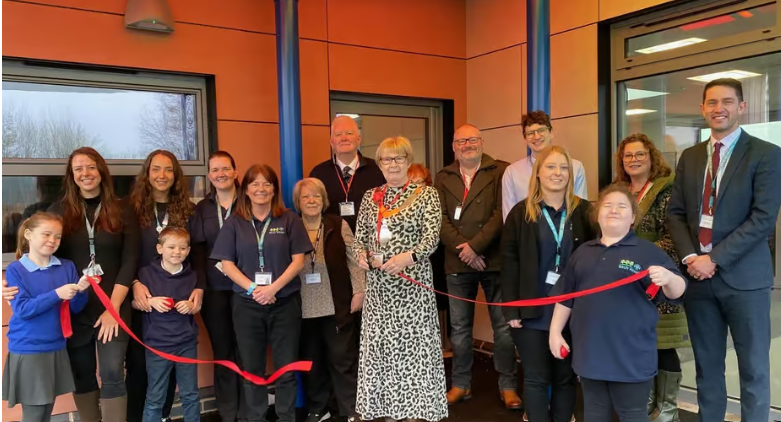
Celebrating the opening of a new classroom block at Birch Wood Special School got me thinking about the relationship between buildings and a culture of inclusion. Physical spaces are never neutral; they send powerful messages about who belongs, what is valued, and how we work together.
In special education, we often speak about meeting a child at their point of need. For many, it sounds like a warm ideal, but for those of us working day‑to‑day with children with complex needs, it is far more than that. It is a principle of design, a commitment, and crucially a practice that must be built into the very foundations of a school.
Building Systems That Flex and Hold
For almost a decade at Birch Wood School, that principle has shaped our entire approach. We have worked to create structures and systems that provide consistency and safety, predictability that nurtures trust. Yet we have also worked equally hard to ensure those systems remain flexible enough to respond to the reality of changing need.
Children grow, develop, regress, leap forward, and shift. Needs evolve. And so must we.
This balance between consistency and flexibility is not a luxury; it is essential. Research by Chapman, Ainscow, Miles and West (2011), commissioned by the National College for School Leadership, found that schools successful in supporting pupils with SEND share a strong sense of purpose underpinned by finely tuned systems and a culture that embraces diversity as a driver of improvement. These schools demonstrate that consistency and flexibility are not opposites, but partners each enabling the other.
Shared Purpose as a Design Principle
Our ability to respond flexibly arises from something deeper: a shared belief, consistently communicated, in every child’s right to the appropriate environment, expertise, and opportunities to reach their personal best.
This belief is not abstract. The UNESCO Global Education Monitoring Report (2024/25) highlights that inclusive leadership is not about heroism but about collective responsibility, moral purpose, and an unwavering commitment to equity. Inclusion becomes sustainable only when it is embedded in the culture, not bolted on as an initiative.
Reimagining Space, Culture, and Leadership of School Sites
For many schools, both specialist and mainstream, this means continually reimagining how our buildings work, repurposing spaces, developing specialist areas, and adapting as our cohorts diversify. At Birch Wood, our environment reflects our community: varied, evolving, and unapologetically ambitious. But a building alone does not create inclusion. The heart of this journey has always been the people. Over time, we have gathered a team who understand that belonging and ambition are not contradictions but companions. Teachers, support staff, specialists, therapists, leaders, families, and children all contribute to a culture shaped by empathy, understanding, and high expectations; at the helm Executive Head, Phil Leaney continues to drive this vision forward.
Increasingly, we have also come to understand that the leadership of our physical sites is central to this culture. Designing a school environment is a leadership act, one that becomes even more significant in a Trust context. Each school brings different architecture, different histories, and different challenges in terms of access, safety, movement, and sensory regulation. This complexity demands a coordinated and thoughtful response.
This is where estates and site teams play a vital role. Too often, their work is seen as operational rather than educational. In reality, they hold a critical link between purpose, safety, accessibility, wellbeing, and long‑term planning. When they become active partners in shaping provision for pupils with complex needs, the impact is profound.
Working closely with our Director of Estates, Nathan Odom and his team, has presented a new opportunity which has the potential to be genuinely transformative. Through shared discussions and a developing understanding of different needs groups, we are beginning to shape our sites in a far more responsive and aligned way to meet need. We are still early in this journey, but the challenges that once felt immovable now feel like problems that can be solved collaboratively.
This partnership strengthens our Trust‑wide understanding of inclusion as something lived and felt; in corridors, classrooms, sensory rooms, outdoor spaces, entrances, thresholds, transitions, and all the subtle moments where children experience school. When our physical environments are led with the same moral purpose we bring to curriculum and pedagogy, they become active contributors to inclusion, not barriers to it.
The Power of Partnership
This commitment to collaboration extends beyond estates leadership. Some of our most transformative work has occurred when we have widened the circle even further, bringing together architects, local authority officers, families, therapists and specialists.
At Discovery, a unique feature is our significant investment in Pedtech, which underpins our ambition to fully embrace Universal Design for Learning approaches. We are fortunate to have Jo Stone, our Pedtech Lead, pioneering these developments and sharing best practice beyond our Trust through Digital Discovery Days and Microsoft Showcase events. Our Chief Technical Officer, Mike Sanderson is as passionate about pupil equity and experience as any educator. Innovative work does not exist in isolation; it has clear links to technology, classroom design, furniture, estates and so on, highlighting the symbiotic relationship between leaders across our Trust as we collectively strive to lead on inclusion.
A scoping review by Sun et al. (2024) found that when professionals from different disciplines collaborate, children with SEND benefit from more holistic and integrated support. Shared goals, regular communication, and leadership that breaks down silos were identified as key enablers of success. We see this reflected in our own practice: the more perspectives we bring into the room, the better our decisions become.
Inclusion Must Be More Than a Word
As the new SEND white paper approaches, these partnerships matter more than ever. There is important work happening, but there is also understandable concern from practitioners and families. Those on the ground know that inclusion is not achieved by rhetoric alone. Special schools are not optional extras they are essential components of a strong, ethical SEND system.
Even Baroness Mary Warnock, whose 1978 report helped shape mainstreaming, later cautioned against what she described as “blind faith in inclusion.” Her message was clear: for some children, specialist provision is not a failure, but the right, necessary, and ethical choice.
More recently, research from Norway by Fasting and Breilid (2024) highlights that inclusion often focuses on physical placement rather than meaningful participation and outcomes. Their work underscores the importance of understanding inclusion as belonging and success not simply location.
Inclusion Requires Investment- Not Proof of Failure
Too often, families and practitioners see children being asked to demonstrate repeated failure before they are allowed access to the provision they truly need. This pattern is not only inefficient it is harmful. No child should have to accumulate trauma, exclusion, or unmet need to “qualify” for the right environment.
This includes the placement of children in Enhanced Resource Provisions (ERPs), Designated Specialist Provisions (DSPs), or similar models when, in truth, they need and deserve a specialist school environment from the beginning. These provisions can offer real value when they are thoughtfully designed, well‑resourced, and anchored in genuine inclusion. There are excellent examples of this being done well, usually when the whole school and leadership are deeply invested and well trained to meet a variety of complex needs. However, when such pathways are used as bolt on, cost‑saving measures or as a means to delay specialist placement, they risk undermining children’s wellbeing.
This tension was articulated powerfully by our parent advocate, Laura Hall, who shared how prior to getting a special school place, a DSP setting often left her feeling that her daughter was “segregated within the school”, present in the building but restricted from participating in its full life. That is not belonging. Belonging is not about proximity; it is about recognition, acceptance, and full participation.
If ERPs, DSPs, and other hybrid models are to succeed, they must be created with care, moral purpose, and a deep respect for complexity, not as a compromise, and never as a budgetary shortcut.
Meeting pupils at their point of need is the opposite of asking them to prove repeated failure.
Looking Ahead with Care
With Birch Wood now part of Discovery Trust, alongside the Trust’s 3 other special schools, I am reminded that genuine inclusion thrives in communities grounded in strong values, collaboration, and integrity. The spaces we have created, both physical and cultural reflect these principles and in partnership with the Trust, they now have the potential to grow even stronger.
In the national context as a Trust we enter this next phase with caution and careful optimism. We are at the beginning of a deeper journey, strengthening our environments, aligning our systems, and expanding our collective understanding of the children we serve. If we are to remain true to the values that underpin real inclusion, then every decision must be anchored in an ambition for equity, dignity, and an unwavering belief that all children deserve the right support, in the right place, at the right time so that they are enabled to truly belong.